Transparent Sheet vs Printed Sheet for Mehndi is one of the most debated topics among professional mehndi artists and serious learners. Every artist eventually faces this decision. Should you trace using a transparent sheet? Or should you rely on a pre-printed design layout?
Both tools promise precision. Only one may align better with your workflow, style, and business goals.
Master this with Professional Cones
The same products used in this guide are available in our shop.
This in-depth guide breaks down technical performance, stain accuracy, design transfer clarity, durability, cultural workflow, and professional use cases. By the end, you will know exactly which sheet enhances your bridal mehndi execution, Arabic flow work, and intricate Indian detailing.

Understanding Transparent Sheet vs Printed Sheet for Mehndi
Before comparing performance, we must define both tools clearly.
Inside this Guide:
What Is a Transparent Sheet in Mehndi?
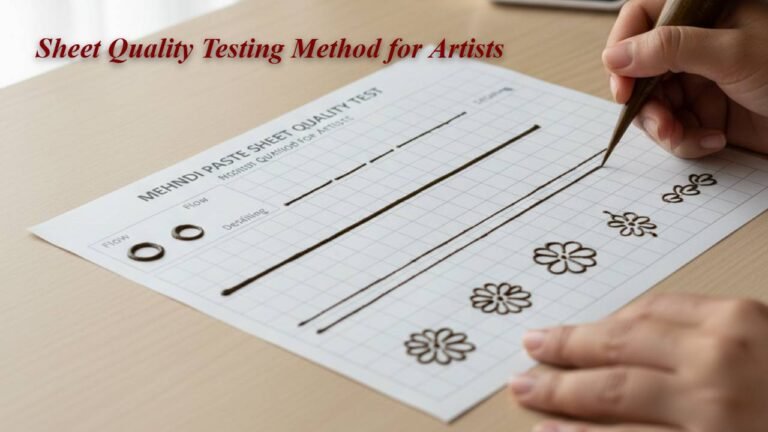
A transparent sheet is a clear plastic tracing sheet used to copy mehndi patterns manually. Artists place it over a reference design and trace using permanent markers.
It allows:
Buy Mehndi Cones Pack of 24 – Natural, Organic & Dark Stain
- Custom resizing
- Pattern editing
- Layer alignment
- Design experimentation
Most professionals use transparent sheets for bridal mehndi drafts and customized Arabic patterns.
What Is a Printed Sheet in Mehndi?
A printed sheet contains a pre-designed mehndi layout printed directly onto paper or thin film. Artists trace directly from the printed template.
Printed sheets:
- Save preparation time
- Offer ready-made layouts
- Support beginner practice
- Provide consistency in repetitive work
They are common in training workshops and bulk festive bookings.
Buy Mehndi Cones Pack of 24 – Natural, Organic & Dark Stain
Transparent Sheet vs Printed Sheet for Mehndi: Material & Structural Differences
Material quality affects precision and durability. The table below compares core structural elements:
| Feature | Transparent Sheet | Printed Sheet |
|---|---|---|
| Material | Plastic film | Paper / thin coated sheet |
| Reusability | High | Limited |
| Tear Resistance | Strong | Moderate |
| Moisture Resistance | Waterproof | Can wrinkle |
| Design Flexibility | Fully editable | Fixed design |
| Longevity | Long-term | Short-term |
Transparent sheets clearly outperform in durability. Printed sheets work better for quick-use scenarios.
Transparent Sheet vs Printed Sheet for Mehndi: Precision & Design Accuracy
Precision defines professional mehndi results. Bridal clients expect symmetry and flow. Arabic patterns demand smooth curvature. Indian bridal designs require micro-level detailing.
Transparent Sheet Performance
Transparent sheets provide:
- Adjustable positioning
- Easy symmetry alignment
- Multi-layer tracing
- Controlled scaling
Artists can refine motifs, adjust spacing, and enhance cultural symbolism.
Printed Sheet Performance
Printed sheets offer:
- Instant reference
- Consistent repetition
- Quick tracing
- Uniform layouts
However, scaling limitations reduce customization flexibility.
For artists specializing in bridal mehndi, transparent sheets usually provide superior structural control.
Transparent Sheet vs Printed Sheet for Mehndi in Bridal Work
Bridal mehndi demands perfection.
Every peacock motif, mandala grid, paisley curve, and dulha-dulhan portrait must align with hand proportions.
Why Transparent Sheets Dominate Bridal Applications
- Enable resizing for different hand lengths
- Support full-arm flow planning
- Allow cultural customization
- Help correct symmetry errors
Bridal mehndi often blends Rajasthani, Mughal, and modern fusion elements. Transparent sheets support this hybrid detailing process.
Where Printed Sheets Work in Bridal Projects
Printed sheets help when:
- Time is limited
- Repeating standard back-hand patterns
- Training assistants
- Practicing layout before final draft
Serious bridal artists rarely rely solely on printed sheets.
Transparent Sheet vs Printed Sheet for Mehndi: Speed vs Control
Speed matters in commercial mehndi bookings.
Control matters in premium bridal sessions.
Here is how both tools compare:
| Performance Factor | Transparent Sheet | Printed Sheet |
|---|---|---|
| Setup Time | Moderate | Fast |
| Design Editing | High | None |
| Bulk Use Efficiency | Medium | High |
| Artistic Freedom | Very High | Limited |
| Error Correction | Flexible | Restricted |
Printed sheets win in speed. Transparent sheets win in control.
Impact on Henna Application Techniques
Henna flow consistency depends on line confidence.
Artists who draft through transparent sheets tend to:
- Develop muscle memory
- Improve curve fluidity
- Refine negative spacing
- Enhance stain placement strategy
Printed sheets support beginners who need guided structure.
Professional mehndi design evolves through tracing mastery. Transparent sheets indirectly improve application skill development.
Cultural & Regional Style Considerations
Different regional mehndi styles respond differently to drafting tools.
Indian Bridal Mehndi
Dense filling. Symmetry grids. Narrative storytelling. Transparent sheets perform better.
Arabic Mehndi
Bold florals. Open spacing. Diagonal flow. Both tools perform well, but transparent sheets allow spacing adjustments.
Pakistani & Mughlai Styles
Fine meshwork. Micro florals. Complex jaal work. Transparent sheets deliver greater precision.
Contemporary Fusion Designs
Personalized initials. Portrait motifs. Minimalist modern styles. Transparent sheets allow customization.
Printed sheets support festival styles like Eid or Karva Chauth where repetition dominates.
Transparent Sheet vs Printed Sheet for Mehndi: Cost Analysis
Budget impacts tool selection.
| Cost Element | Transparent Sheet | Printed Sheet |
|---|---|---|
| Initial Cost | Slightly higher | Lower |
| Long-Term Value | High | Low |
| Replacement Frequency | Rare | Frequent |
| Workshop Utility | Reusable | Disposable |
| Environmental Impact | Reusable | Paper waste |
Professionals view transparent sheets as investment tools. Printed sheets function as consumables.
Skill Level Suitability
For Beginners
Printed sheets:
- Provide visual guidance
- Reduce early mistakes
- Support learning Arabic curves
- Improve spacing understanding
For Intermediate Artists
Transparent sheets:
- Encourage structural thinking
- Improve layout planning
- Enhance symmetry control
For Advanced Bridal Artists
Transparent sheets become essential tools.
They allow:
- Portfolio-quality execution
- Client customization
- Cultural detailing
- Premium pricing positioning
Performance in Large-Scale Bookings
Wedding seasons in India demand speed and precision.
During group bookings:
- Printed sheets accelerate repetitive patterns
- Transparent sheets support head artist supervision
- Assistants trace printed sheets
- Lead artist drafts bridal designs using transparent sheets
Successful mehndi teams often use both strategically.
Practical Workflow Comparison
Here is how workflow differs:
Transparent Sheet Workflow
- Select design reference
- Trace manually
- Adjust proportions
- Align with hand structure
- Refine spacing
- Apply henna
Printed Sheet Workflow
- Print selected design
- Place under tracing surface
- Follow lines directly
- Apply henna
Transparent sheets demand preparation. Printed sheets demand minimal setup.
Common Mistakes When Choosing Between Them
Many artists make avoidable mistakes:
- Choosing printed sheets for high-end bridal work
- Avoiding transparent sheets due to initial effort
- Ignoring durability in humid environments
- Using low-quality plastic sheets that smudge
Selecting the wrong tool can affect stain clarity and design symmetry.
Transparent Sheet vs Printed Sheet for Mehndi: Final Performance Verdict
Let’s summarize performance clearly.
| Performance Category | Winner |
|---|---|
| Customization | Transparent Sheet |
| Speed | Printed Sheet |
| Bridal Precision | Transparent Sheet |
| Beginner Practice | Printed Sheet |
| Long-Term Investment | Transparent Sheet |
| Bulk Festival Work | Printed Sheet |
Transparent sheets dominate premium and customized mehndi design. Printed sheets dominate repetitive commercial bookings.
Professionals rarely depend on only one.
They combine both based on workflow.
Frequently Asked Questions
1. Which is better for bridal mehndi: transparent sheet or printed sheet?
Transparent sheets perform better for bridal mehndi because they allow resizing, symmetry control, and personalized detailing.
2. Do printed sheets affect mehndi stain quality?
Printed sheets do not directly affect stain quality. However, rigid layouts may limit flow consistency.
3. Can beginners start with transparent sheets?
Beginners can use transparent sheets, but printed sheets provide easier initial guidance.
4. Are transparent sheets reusable?
Yes. High-quality transparent sheets are reusable and durable for long-term practice and professional drafting.
5. Should professional mehndi artists use both?
Most experienced artists combine transparent sheets for bridal drafting and printed sheets for bulk bookings.
Conclusion
Transparent Sheet vs Printed Sheet for Mehndi ultimately depends on your artistic goals, client expectations, and workflow structure.
Artists focused on bridal mastery and cultural detailing benefit more from transparent sheets. Practitioners handling bulk festive bookings benefit from printed sheets. Serious mehndi professionals treat tools as strategic assets rather than shortcuts.
If you aim to elevate your bridal precision and Arabic flow artistry, explore the drafting method that aligns with your growth as an artist.
More Design Inspiration